
Most of us drive, walk, or bike over a bridge without giving much thought to how it was made. We rarely pause to consider who designed it or the story behind its creation. Today, I want to take you on a journey to explore the incredible world of infrastructure around us.
Let’s start with a simple yet profound question: What is a bridge?
A bridge is a structure built to span a physical obstacle. These obstacles include rivers, valleys, or roads. Bridges allow the transportation of vehicles, people, or goods. It accomplishes this by transferring loads to its supports. These supports are known as piers or abutments. The loads are transferred through structural elements like beams, arches, or trusses.
Now, let’s focus on a unique type of bridge: the Pontoon Bridge.
A pontoon bridge is a floating structure supported by pontoons—buoyant platforms that keep the bridge afloat. These bridges are often temporary and ideal for situations where building a permanent bridge is impractical or unnecessary.
How Bridges Are Built and Designed
Bridge Design and Construction
Engineers evaluate site conditions, load requirements, and environmental factors to decide the best type of bridge and materials (e.g., steel, concrete). Construction begins with laying the foundations to anchor the structure securely. Next, the superstructure—comprising the deck, girders, and other elements—is assembled to span the obstacle.
Pontoon Bridge Design and Construction
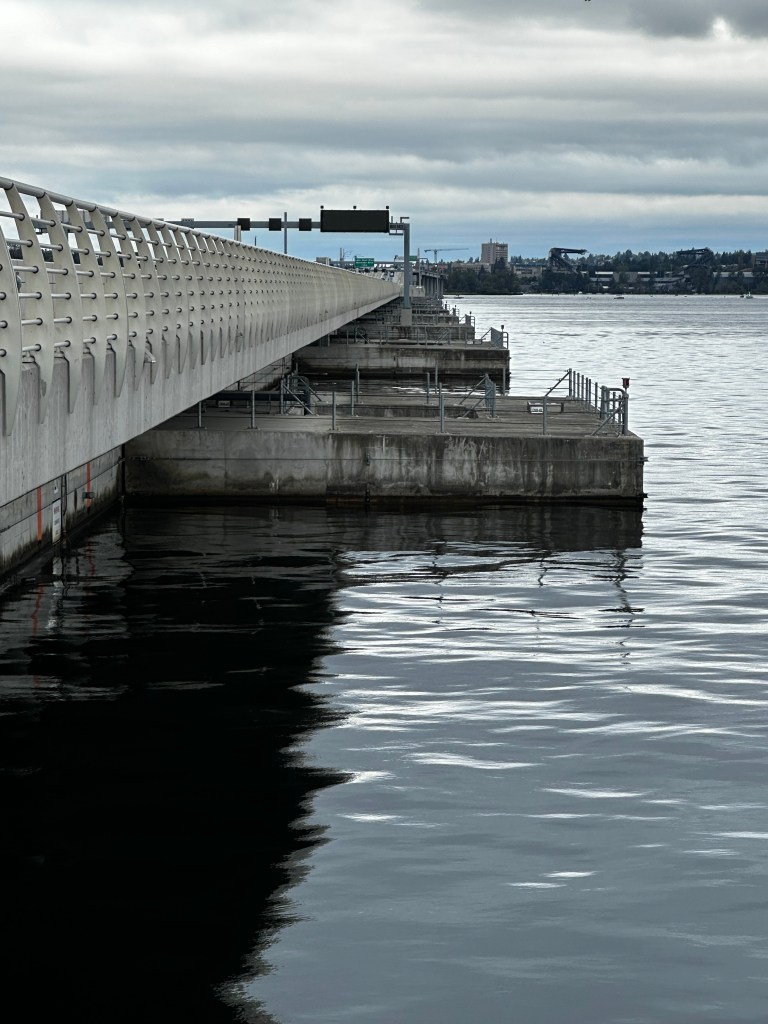
For pontoon bridges, engineers calculate the buoyancy required to support the bridge and its load. Modular pontoons are floated into position and anchored to the riverbed or shoreline. A lightweight deck is installed atop the pontoons, often reinforced with guardrails or additional supports for stability. These designs account for wave action, currents, and load distribution to ensure safety and functionality.
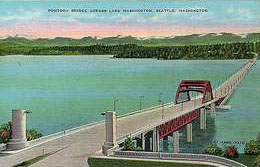
Pontoon bridges blend engineering ingenuity with practical problem-solving. Two of the most iconic examples lie right here on Lake Washington in Seattle: the Homer M. Hadley Memorial Bridge and the Evergreen Point Floating Bridge.
Engineering of the Evergreen Point Floating Bridge
The Evergreen Point Floating Bridge, officially known as the Governor Albert D. Rosellini Bridge, is a masterpiece of modern civil engineering. Spanning Lake Washington, this bridge holds the title of the world’s longest floating bridge at 7,710 feet (2,350 meters). Its engineering addresses the unique challenges posed by the lake’s depth and soft sediment, which make traditional foundation techniques impractical.
Key Engineering Features:
- Concrete Pontoon Design:
The bridge rests on 77 massive concrete pontoons, each functioning as a buoyant structure. These pontoons are hollow, sealed watertight, and provide the necessary buoyancy to support the roadway above. Each pontoon displaces a volume of water. This volume is equal to the total weight of the structure and traffic it supports. This design adheres to Archimedes’ principle. - Anchoring System:
Wind, waves, and currents can cause lateral movement. To prevent this, the pontoons are anchored to the lakebed. They are secured using high-tension steel cables. These anchors are strategically placed to ensure stability and resistance to environmental forces. - Roadway Construction:
The roadway is constructed on top of the pontoons using reinforced concrete. Steel beams ensure its durability and strength. Expansion joints and shock absorbers help the bridge flex with the water’s movement. This action reduces stress on the structure. - Seismic Resilience:
The bridge incorporates modern seismic-resistant technology. Flexible connections are integrated to absorb energy during an earthquake. Damping systems minimize damage to the bridge and ensure safety. - Multimodal Design:
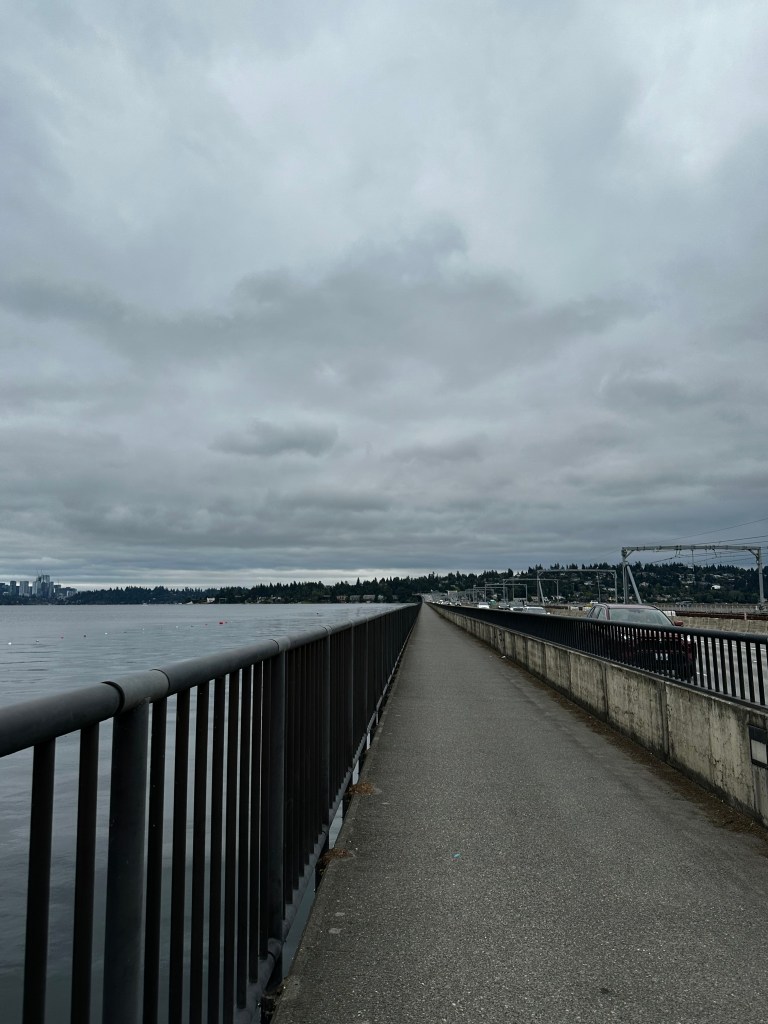
The bridge includes dedicated lanes for bicycles and pedestrians, demonstrating a commitment to sustainable and inclusive design. It is also future-proofed for potential light rail integration. - Stormwater Management:
Environmental considerations were critical in the design. A comprehensive drainage system collects and treats stormwater runoff from the bridge, preventing contamination of Lake Washington.
Engineering of the Homer M. Hadley Memorial Bridge
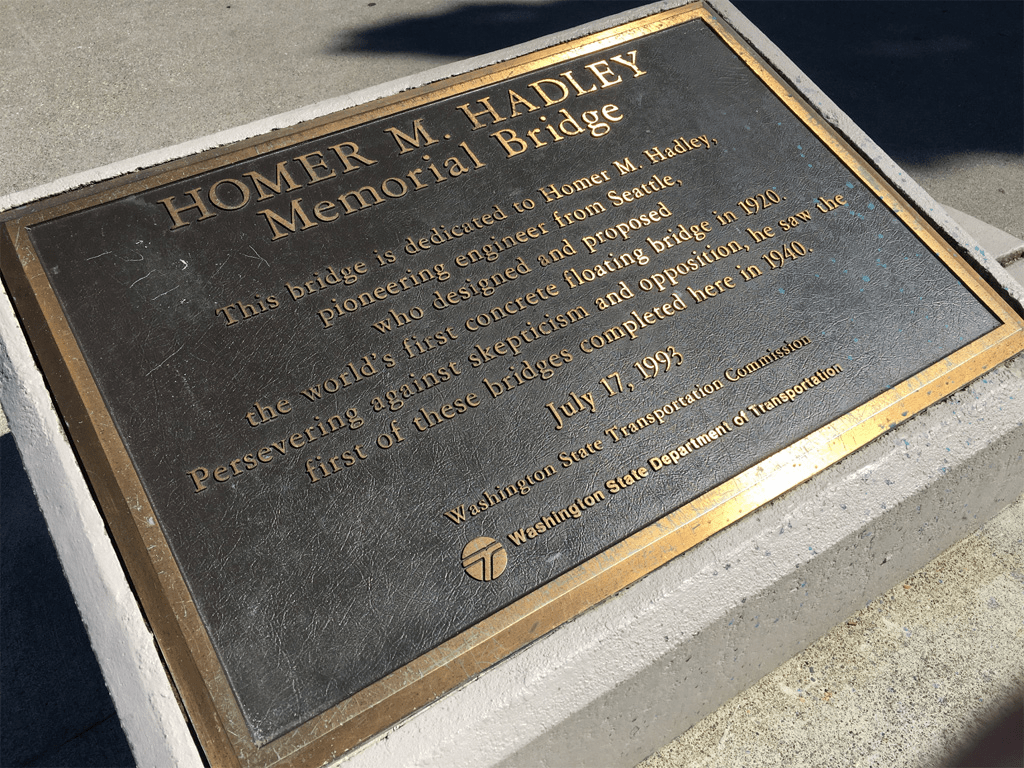
The Homer M. Hadley Memorial Bridge, completed in 1989, is located just south of the Evergreen Point Floating Bridge. It spans 5,811 feet (1,772 meters) across Lake Washington. The bridge carries four westbound lanes, including an HOV lane. It also features a pedestrian and bicycle path. Named after the visionary engineer Homer M. Hadley, this bridge builds upon his pioneering ideas for floating bridges.
Key Engineering Features:
Historical Innovation:
The Hadley Bridge reflects the early application of concrete buoyancy principles in large-scale infrastructure. Its construction showcased the practicality of floating bridges in deep-water regions, setting the stage for future advancements.
Pioneering Pontoon Design:
The Hadley Bridge utilizes hollow concrete pontoons. They are similar to the Evergreen Point Bridge. However, there are structural differences reflecting the technology available at the time of its construction. The pontoons are smaller than those in the newer Evergreen Point Bridge. They are similarly anchored to the lakebed using steel cables.
Load Distribution:
Engineers designed the bridge to handle dynamic loads, including vehicle traffic, wind, and wave forces. The pontoons distribute these loads evenly across the water’s surface, reducing stress on individual sections.
Deck and Barriers:
The bridge’s deck is made of reinforced concrete, supported by a network of steel girders. Safety features include a 54-inch (140 cm) outer railing for the pedestrian and bicycle path. Additionally, there is a 35-inch (89 cm) concrete barrier separating the path from vehicular traffic.
Flexibility and Durability:
Expansion joints and flexible connectors are crucial. They enable the bridge to move slightly with changing water levels. They also allow it to adapt to temperature variations and seismic activity. This flexibility ensures the structure can withstand the environmental stresses unique to floating bridges.
Pedestrian and Bicycle Infrastructure:
Like its counterpart, the Hadley Bridge includes a multimodal pathway. This design emphasizes the integration of transportation modes. It also promotes non-motorized transit.
Comparison of the Two Bridges
| Feature | Evergreen Point Floating Bridge | Homer M. Hadley Memorial Bridge |
|---|
| Length | 7,710 feet (2,350 meters) | 5,811 feet (1,772 meters) |
| Pontoon Design | Modern, larger pontoons with improved buoyancy | Earlier, smaller pontoons using initial designs |
| Anchoring System | Advanced high-tension cables | Conventional anchoring system for the era |
| Seismic Resilience | Integrated modern seismic-resistant technology | Limited to basic seismic considerations |
| Multimodal Design | Lanes for bicycles, pedestrians, and potential rail | Lanes for bicycles and pedestrians |
| Year Completed | 2016 | 1989 |
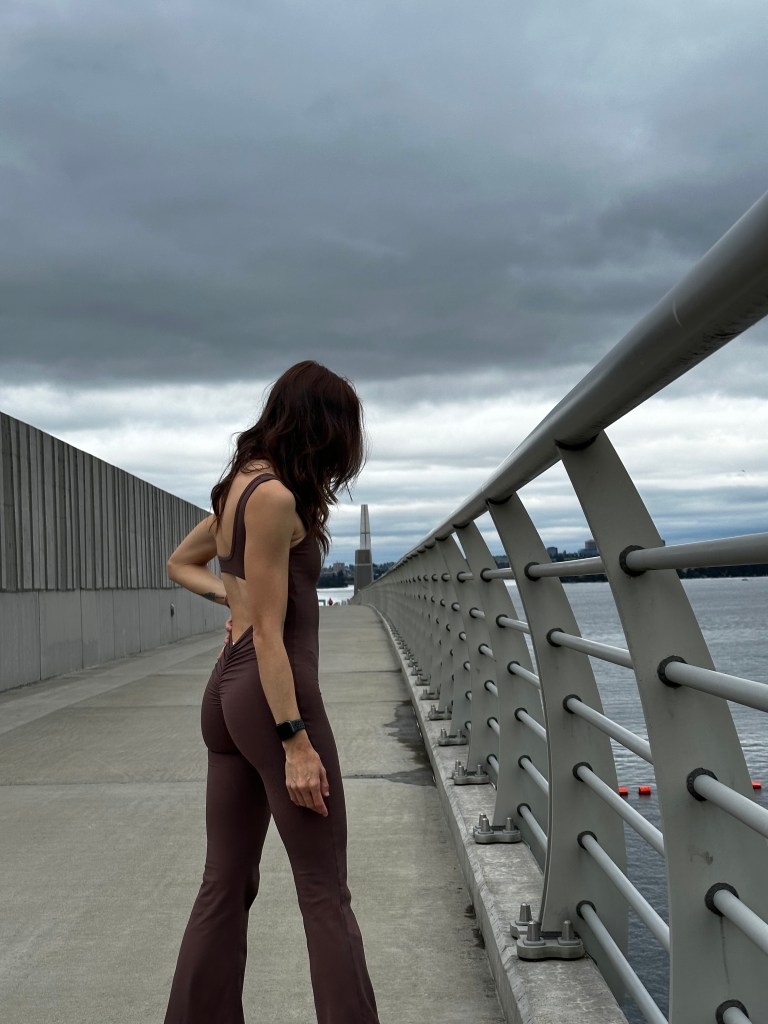
Connecting the Two Bridges
The Homer M. Hadley Memorial Bridge laid the foundation for floating bridge technology in the Pacific Northwest. It embodies the vision and persistence of its namesake. The Evergreen Point Floating Bridge takes these ideas to new heights. It incorporates advancements in materials, design, and sustainability.
Together, these bridges represent not only essential infrastructure but also a legacy of innovation in civil engineering. They showcase creative applications of buoyancy, load distribution, and material science principles. These applications help overcome challenges posed by natural landscapes.
Conclusion: A Celebration of Engineering Ingenuity
Floating bridges like the Evergreen Point and Homer M. Hadley Memorial Bridges remind us of the profound role civil engineering plays in shaping our world. They are not merely functional structures. These structures are feats of imagination and determination. They overcome natural obstacles to connect communities and improve lives.
When we take the time to learn about the world around us, it enriches our appreciation for the built environment. This includes the bridges we cross, the roads we travel, and the infrastructure we depend on. Civil engineering isn’t just about construction; it’s about creativity, problem-solving, and building connections, both literal and figurative.
So, the next time you cross a bridge, take a moment to think about the minds that designed it. Consider the challenges they overcame. Reflect on the incredible stories behind it. Civil engineering makes the impossible possible, and that’s something worth celebrating.
– Alexis
Sources:
- Washington State Department of Transportation. (n.d.). SR 520 Bridge Replacement and HOV Program. Retrieved November 21, 2024, from https://wsdot.wa.gov/construction-planning/major-projects/sr-520-bridge-replacement-and-hov-program
- Washington State Department of Transportation. (n.d.). Homer Hadley Memorial Bridge. Retrieved November 21, 2024, from https://wsdot.wa.gov/
- Wikipedia contributors. (n.d.). Evergreen Point Floating Bridge. In Wikipedia. Retrieved November 21, 2024, from https://en.wikipedia.org/wiki/Evergreen_Point_Floating_Bridge
- Williamson, K. (2016, April 11). World’s longest floating bridge opens in Seattle. CNN. Retrieved from https://www.cnn.com/
- O’Connor, J. (2020, March 18). The history of floating bridges: Homer Hadley’s vision. Seattle Times. Retrieved from https://www.seattletimes.com/
- Heiner, B. (2016). Engineering challenges of floating bridges. Journal of Bridge Engineering, 21(3), 1-12. https://doi.org/10.1061/(ASCE)BE.1943-5592.0000893
